
If you didn't mean to imply that 53% don't pay any taxes at all, then really what was your point?
Read the Article at HuffingtonPost

We have the highest corporate tax rate, or one of them, in the OECD nations.Actually, as measured in terms of share of GDP, the U.S. has the lowest corporate tax burden of any OECD nation. While the official tax bracket may seems high -- 35 percent -- if one takes into account various loopholes and tax dodges, the effective tax rate is considerab
What all this means is that in the late 1980s, the U.S. was nearly the lowest taxed nation in the world, and a quarter century later we're nearly the highest.Totally untrue. As measured in terms of total tax revenue as a share of overall GDP the average tax burden for countries that are members of the Organizati
Tax the 53% that pay NO income taxes...
At a hearing last month, Senator Charles Grassley said, "According to the Joint Committee on Taxation, 49 percent of households are paying 100 percent of taxes coming in to the federal governmentThe Center on Budget and Policy Priorities." At the same hearing, Cato Institute Senior Fellow Alan Reynolds asserted, "Poor people don't pay taxes in this country." Last April, referring to a Tax Policy Center estimate of households with no federal income tax liability in 2009, Fox Business host Stuart Varney said on Fox and Friends, "Yes, 47 percent of households pay not a single dime in taxes."
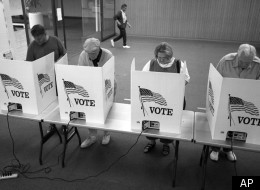

Yesterday’s elections were a mixed bag for Democrats. There were positive results for liberals on three key ballot initiative s they cared most about. The big win of the night was in Ohio where the anti-union SB5 was overwhelmi ngly repealed by the voters by a margin of 61-39 percent. By a similarly impressive margin of 60-40 percent, the voters in Maine also rejected a new Republican law that would have ended same day registrati on. And in a surprising turnaround from only a few weeks ago the voters of Mississipp i strongly rejected the radically anti-choic e “personhoo d amendment, ” though in a defeat for liberals the voters of Mississipp i also approved a law requiring photo ID to vote.
While the night was generally good for progressive policies at the ballot box, it was not as good a night for Democrats running for office.
On net Democrats lost state legislative seats and may have lost control of two important state legislativ e chambers. That’s significan t given that only four states (Mississip pi, Virginia, New Jersey and Louisiana) held regular legislativ e elections this year.
In Virginia Democrats lost seats in the lower chamber. Depending on the results of a recount, Democrats may end up losing two Senate seats, putting the balance of power at 20 D – 20 R with the Republican Lt. Gov giving the GOP a working majority.
In Mississippi the results are still being counted, but it looks like the Republican s may have barely netted enough seats to take control of the House of Representa tives for the first time since reconstruc tion.
In New Jersey Democrats did about as well as they did in 2009, gaining only a single state legislative seat.
Some national Democrats may be talking heart in how completely the anti-union law was defeated in Ohio, but they should be more worried about the fact that in the state legislative races Democrats did only as well as or worse than they did in the 2009 election, and 2009 was not a good year for Democrats.

"I am very passionate at these events as well as at my town halls...I was working on an empty stomach and had a quicker fuse than normal."
He never had a fillibuste==========r-proof senate. The independen t Lieberman proved that. Changing the supermajor ity rule = the "nuclear option". I could go on and on dissecting your replies. But it look so much like a wild conspiracy theory that I just don't think it would go anywhere.
I see no reasonable motive for the democrats to be doing almost any of what you say. There's just no no motive. I DO think that Obama was trying to cut a deal with the powers that be/were because it was the only practical hope of getting ANYTHING passed. As it was, the badly watered down bill barely squeeked by. Nothing more would have had any chance at all.
Do prematurely born babies who require months in a NICU and lifelong special education and support on the taxpayers' dime have a "right to life"?
Do people who need heart transplants but can't afford them have a "right to life"?

Systematic studies of fetal neurologicMellor and his team detected the presence of such chemicals as adenosine, pregnanoloal function suggest, however, that there are major difference s in the in utero environmen t and fetal neural state that make it likely that this assumption is substantia lly incorrect.
All persons born or naturalized in the United States, and subject to the jurisdicti on thereof, are citizens of the United States and of the State wherein they reside. No State shall make or enforce any law which shall abridge the privileges or immunities of citizens of the United States; nor shall any State deprive any person of life, liberty, or property, without due process of law; nor deny to any person within its jurisdicti on the equal protection of the laws.